

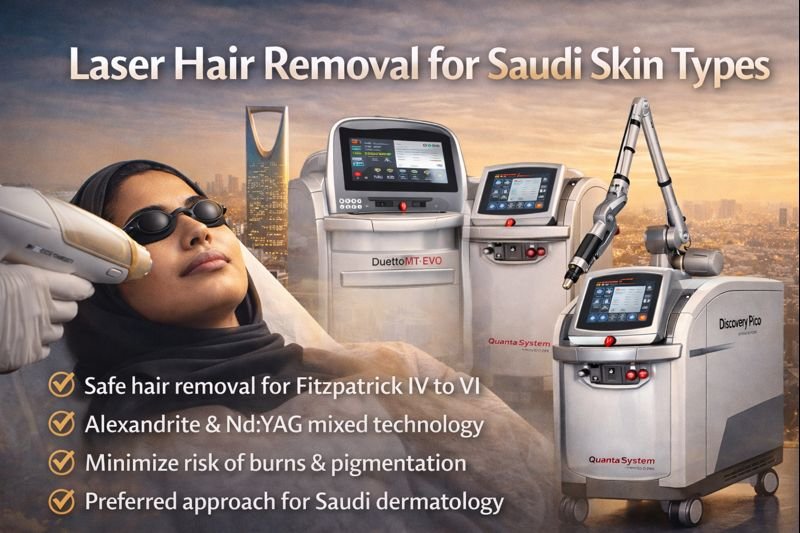
Laser hair removal for Saudi skin types requires more than high power or fast sessions. It requires the right wavelength selection, deep understanding of skin biology, and technology designed for diversity.
In Saudi Arabia, dermatologists routinely treat patients with Fitzpatrick skin types IV to VI. These skin types respond differently to laser energy and carry a higher risk of adverse effects when technology is not chosen carefully. This is why mixed technology platforms that combine Alexandrite and Nd:YAG wavelengths are now considered the clinical gold standard.
Understanding Saudi Skin Types in Daily Dermatology Practice
Saudi Arabia has a wide range of skin phototypes, but darker and medium-dark skin tones are most common in clinical settings.
Fitzpatrick skin types commonly treated in KSA
Most patients fall between Fitzpatrick IV, V, and VI. These skin types contain higher epidermal melanin, which increases the risk of heat absorption during laser procedures.
Why skin type matters more than hair color
Hair color alone does not determine treatment safety. Epidermal melanin competes with hair follicle melanin for laser energy. Ignoring skin type increases the likelihood of burns and pigmentation issues.
Clinical risks of incorrect technology selection
Clinics that treat diverse Saudi skin types benefit from working with an aesthetic medical devices distributor in Saudi Arabia that provides SFDA-compliant laser platforms, clinical training, and long-term technical support.
The Core Challenge of Laser Hair Removal for Saudi Skin Types
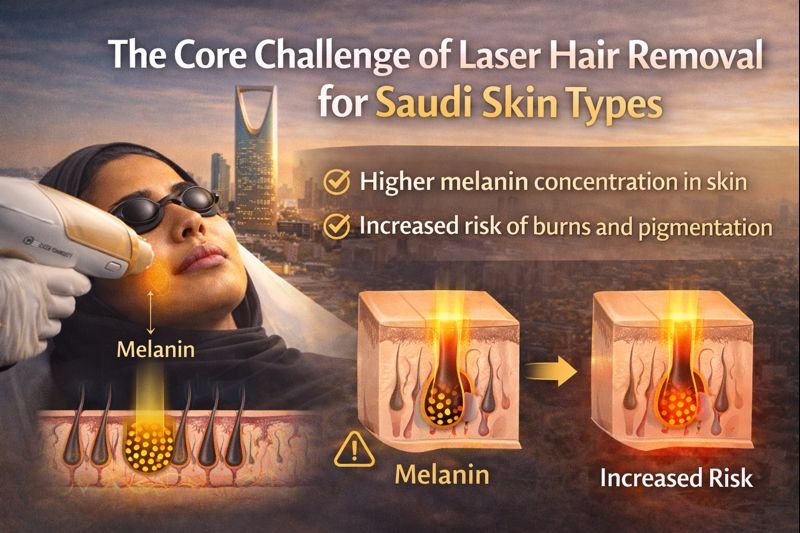
Laser hair removal works by targeting melanin in the hair follicle. In darker skin, this process becomes more complex.
Higher melanin concentration and laser interaction
In Fitzpatrick IV to VI skin, epidermal melanin absorbs more energy. This raises surface temperature quickly if the wavelength is not appropriate.
Increased risk of adverse effects
Improper systems increase the risk of burns and pigmentation changes. This is one of the most common causes of dissatisfaction in laser hair removal treatments across the region.
Why single-wavelength systems fall short
Single-wavelength platforms force clinicians to compromise. Either safety is prioritized at the expense of efficacy, or results are achieved with higher risk.
Alexandrite and Nd:YAG Lasers. Different Physics, Different Roles
Understanding wavelength behavior is essential for safe and effective treatment planning.
How Alexandrite wavelength works
Alexandrite lasers have strong melanin absorption. They are highly effective for lighter skin types and fine hair but require caution on darker or tanned skin.
Strengths of Alexandrite technology
For Fitzpatrick I to III, Alexandrite delivers fast and efficient hair reduction with fewer sessions.
Limitations on darker or tanned skin
On darker skin, Alexandrite increases epidermal heating. This raises complication risk when used alone.
Nd:YAG Laser Technology for Darker Skin Safety
Nd:YAG lasers operate at a longer wavelength, offering a different interaction profile.
Deeper penetration with lower epidermal absorption
Nd:YAG energy bypasses surface melanin and targets deeper hair follicles. This makes it safer for darker skin types.
Why Nd:YAG is preferred for Fitzpatrick IV to VI
Lower melanin absorption reduces the risk of burns and pigmentation changes, especially in patients with recent sun exposure.
Safety versus efficacy balance
Nd:YAG is safer but may require more sessions on finer hair when used alone. This is where combined technology becomes critical.
Nd:YAG vs Alexandrite Laser. Why Comparison Alone Is Not Enough
Clinics often compare wavelengths as if one must replace the other. Clinically, this approach is outdated.
Why choosing one wavelength creates compromise
No single wavelength performs optimally across all skin types and hair textures common in Saudi Arabia.
Operational challenges in busy clinics
Switching devices between patients slows workflow and increases error risk, especially in high-volume practices.
Need for adaptive treatment planning
Modern dermatology requires flexibility, not limitation.
Mixed Technology Platforms. The Gold Standard Approach
Mixed technology systems integrate Alexandrite and Nd:YAG into a single platform.
What mixed technology really means
It allows dermatologists to select the safest and most effective wavelength per patient, per session, without changing devices.
Clinical logic behind dual wavelengths
Alexandrite delivers speed and efficacy where appropriate. Nd:YAG ensures safety for darker skin and tanned patients.
Treating diverse Saudi skin tones confidently
This approach aligns with patient diversity in Saudi clinics and supports consistent outcomes.
Duetto MT EVO. Designed for Saudi Dermatology Clinics
Duetto MT EVO is designed for dermatology clinics that treat a wide range of skin tones every day. In the Saudi market, where Fitzpatrick IV to VI skin types are common, flexibility and safety are not optional. They are clinical requirements.
Dual Wavelength Capability in One Platform
Duetto MT EVO combines Alexandrite and Nd:YAG wavelengths in a single system. This allows dermatologists to adjust treatment protocols based on skin type, hair depth, and sun exposure without switching devices or compromising workflow.
Optimized Protocols for Fitzpatrick IV to VI Skin Types
The availability of Nd:YAG wavelength enables safer treatment for darker and tanned skin. Dermatologists can prioritize epidermal safety while maintaining effective follicular targeting, even in patients with higher melanin concentration.
Workflow Efficiency and Clinical Control
A single dual-wavelength platform reduces setup time, minimizes operator error, and supports consistent treatment parameters. This is especially important for high-volume clinics where efficiency directly affects clinical outcomes and patient experience.
Safe Laser Hair Removal for Tanned Skin in Saudi Arabia
In Saudi Arabia, seasonal and year-round sun exposure is unavoidable. Laser technology must be able to adapt to changing skin conditions safely.
Managing Seasonal Tanning and Sun Exposure
The Nd:YAG wavelength allows deeper penetration with reduced epidermal absorption. This makes it suitable for treating patients with recent sun exposure while lowering the risk of burns and post-inflammatory hyperpigmentation.
Parameter Selection Based on Clinical Judgment
Mixed technology enables dermatologists to move away from rigid protocols. Wavelength selection, fluence, and pulse duration can be adjusted based on individual patient assessment rather than fixed device limitations.
Patient Education and Expectation Management
Clear explanation of wavelength choice and treatment planning improves patient trust. Informed patients are more compliant and more satisfied with long-term treatment outcomes.
Clinical Outcomes and Patient Trust in the Saudi Market
Long-term success in laser hair removal depends on safety, consistency, and predictability of results.
Reduced Adverse Events
Proper wavelength selection significantly lowers the incidence of burns, blistering, and pigmentary complications, especially in darker skin types.
Higher Patient Satisfaction
Patients experience safer treatments with more predictable outcomes, which improves retention and referral rates.
Stronger Clinic Reputation
Consistent results across different skin tones build credibility. In the Saudi market, reputation is closely tied to perceived safety and professionalism.
Technology Selection as a Clinical Responsibility
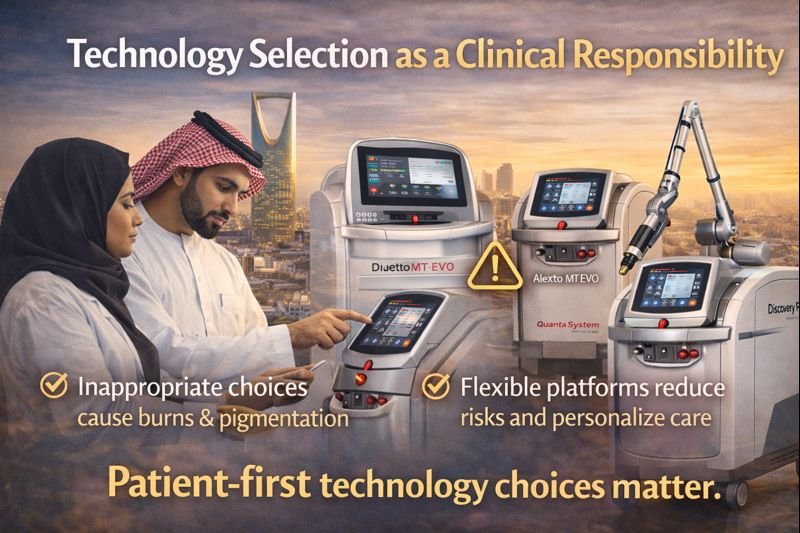
Laser selection is not only a financial or operational decision. It is a clinical responsibility that directly affects patient outcomes.
Patient-First Treatment Planning
Effective technology adapts to patient needs. Mixed wavelength systems support individualized care rather than forcing patients to fit device limitations.
Alignment with Dermatology Best Practices
Using both Alexandrite and Nd:YAG wavelengths reflects current evidence-based laser medicine and international dermatology standards.
Setting Long-Term Standards for Saudi Clinics
Clinics that invest in adaptive, mixed technology systems establish higher benchmarks for safety, quality, and clinical excellence in Saudi Arabia.
Conclusion
Laser hair removal for Saudi skin types cannot rely on a single wavelength approach anymore. The diversity of skin tones, frequent sun exposure, and high patient expectations demand technology that adapts clinically, not commercially.
Mixed technology platforms that combine Alexandrite and Nd:YAG wavelengths allow dermatologists to deliver safe, effective, and consistent results across Fitzpatrick IV to VI skin types. This approach reduces complications, improves patient confidence, and supports long-term clinic credibility. For Saudi dermatology clinics, mixed technology is no longer an upgrade. It is the standard of care.
Key Takeaways
- Saudi clinics treat a high percentage of Fitzpatrick IV to VI skin types.
- Single-wavelength laser systems create safety or efficacy compromises.
- Alexandrite offers speed and efficacy but requires caution on darker skin.
- Nd:YAG provides deeper penetration and higher safety for tanned or dark skin.
- Mixed technology allows personalized treatment without workflow disruption.
- Dual-wavelength platforms improve outcomes, safety, and patient trust.
FAQs
Q. Why is mixed technology better than a single laser wavelength?
Because no single wavelength performs optimally across all Saudi skin types. Mixed technology allows dermatologists to select the safest and most effective wavelength based on skin tone, hair thickness, and sun exposure.
Q. Is Nd:YAG always safer for dark skin?
Nd:YAG is safer for Fitzpatrick IV to VI because it has lower epidermal melanin absorption. However, using Nd:YAG alone may reduce efficacy for certain hair types, which is why combining it with Alexandrite is clinically superior.
Q. Can Alexandrite be used on Saudi skin types safely?
Yes, but only with careful patient selection and parameter control. Alexandrite works best on lighter skin tones and untanned skin. Mixed technology allows safer use when combined with Nd:YAG protocols.
Q. How does mixed technology reduce complications?
By matching wavelength selection to skin type, mixed systems reduce overheating of the epidermis. This lowers the risk of burns, blistering, and post-inflammatory hyperpigmentation.
Q. Is mixed technology suitable for high-volume laser clinics?
Yes. Dual-wavelength platforms improve workflow efficiency by eliminating the need to switch devices. This reduces treatment time and operator error while maintaining safety.
Q. Why is this approach especially important in Saudi Arabia?
High sun exposure, darker skin tones, and year-round demand for laser hair removal make safety-critical technology essential. Mixed wavelength systems are better aligned with regional clinical realities.