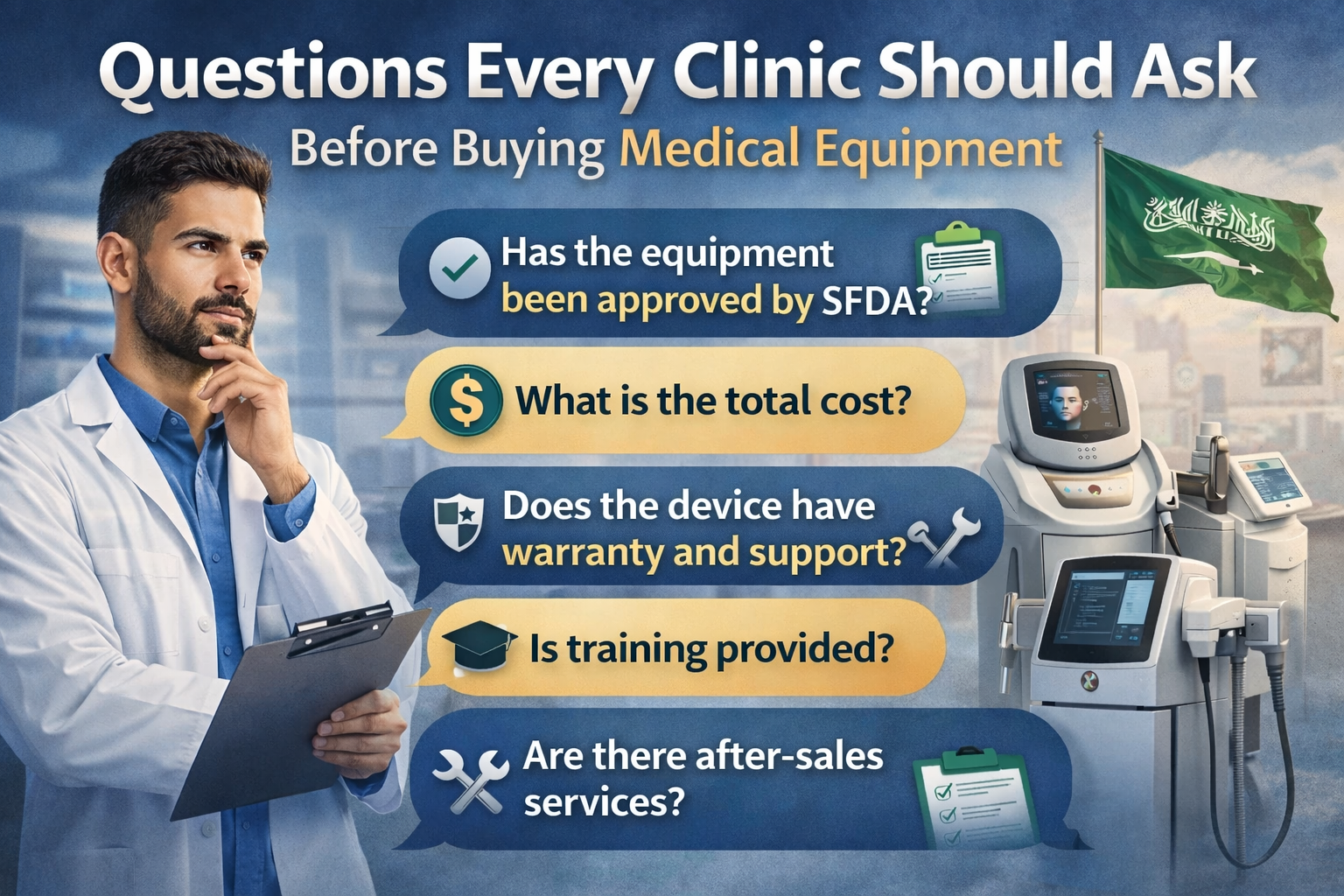
Buying medical equipment is one of the most important decisions a clinic will make. It affects clinical outcomes, regulatory exposure, operational efficiency, and long-term profitability.
In Saudi Arabia, where healthcare standards are rising and competition is increasing, equipment selection must be strategic. A discounted price or a popular brand name is not enough.
This guide provides a practical buying medical equipment checklist clinics can use before signing any agreement. It combines regulatory awareness, clinical insight, and financial clarity to support smarter decisions.
Quick Overview: Medical Equipment Buying Checklist for Clinics
Before we go into detailed explanations, here is the structured checklist every clinic should review:
• Strategic alignment with core treatments
• Suitability for local patient demographics
• Clear understanding of core technology
• Total cost of ownership and break-even timeline
• Verified SFDA compliance
• Distributor strength and technical support
• Operational workflow impact
• Long-term scalability
• Decision bias awareness
Each section below explains how to evaluate these factors properly.
1. Is This Equipment Aligned With Our Clinic Strategy?
Before evaluating specifications, ask a fundamental question:
What clinical problem are we solving?
Many clinics purchase devices based on trends rather than demand. That leads to underutilized machines and slow return on investment.
Clarify:
- Does this device support our top three revenue treatments?
- Is there proven demand in our city?
- Does it expand our service portfolio or duplicate existing capability?
- Does it strengthen our competitive positioning?
For example, a dermatology clinic dealing with acne scars and pigmentation requires different technology compared to a high-volume laser hair removal center. A plastic surgery practice may prioritize resurfacing and skin tightening systems.
Effective clinic equipment evaluation starts with strategic clarity, not product brochures.
2. Is Technology Suitable for Our Patient Demographics?
In Saudi Arabia, patient demographics matter.
Fitzpatrick skin types IV and V are common. This increases the risk of post-inflammatory hyperpigmentation and requires precise energy control.
When evaluating aesthetic or therapeutic devices, ask:
- Does the system allow adjustable pulse duration?
- Is fluence finely controllable?
- Does it provide wavelength flexibility?
- Are there protocols designed for darker skin types?
For example, in aesthetic lasers, wavelength selection directly influences chromophore targeting. Devices that allow controlled thermal damage reduce complication risk in melanin-rich skin.
Downtime tolerance must also be considered. Many patients prefer treatments with minimal recovery, especially during peak seasons.
Selecting medical devices for clinics in Saudi Arabia must reflect both clinical safety and cultural expectations.
3. Do We Fully Understand the Core Technology?
Before purchasing, the medical team should clearly understand the technology, not just the marketing.
Ask the supplier to explain:
- Wavelength and its clinical target
- Pulse duration range
- Spot size options
- Energy delivery system
- Cooling mechanisms
- Safety protocols
For example:
In laser systems, wavelength determines tissue interaction. Pulse duration affects how heat is delivered. Spot size influences treatment speed. Thermal control mechanisms protect surrounding tissue.
In diagnostic equipment, resolution, calibration requirements, and software integration become critical.
A clinic should never purchase equipment it cannot technically explain.
Medical device purchase questions should include both clinical and engineering clarity.
4. What Is the Total Cost of Ownership?
The purchase price is only part of the investment.
Before signing, calculate:
- Annual maintenance cost
- Calibration requirements
- Consumables and disposables
- Software upgrade fees
- Warranty coverage
- Spare part availability
Some platforms require recurring consumables that increase operational costs. Others operate with minimal ongoing expenses.
Break-even analysis should include:
- Average session price in your city
- Estimated monthly case volume
- Marketing cost to launch the service
- Depreciation timeline
If the projected break-even exceeds realistic volume expectations, reconsider.
A structured buying medical equipment checklist for clinics must include financial modeling, not just enthusiasm.
5. Is the Device Properly Registered and Compliant?
In Saudi Arabia, regulatory compliance is not a formality. It is a legal obligation.
Before purchasing any medical or aesthetic device, your clinic must verify more than verbal assurances.
Ask for proof of:
- Official SFDA registration number
- Device listing in the SFDA system
- Valid importation documentation
- UDI traceability where applicable
- Post-Market Surveillance (PMS) process
- Clear complaint and adverse event reporting structure
Do not rely on statements like “it is approved” or “all our devices are compliant.” Ask to see documentation.
Clinics should understand that during inspections, responsibility does not fall only on the distributor. The clinic must also demonstrate that the device was legally sourced and properly documented.
In practical terms, confirm:
- Can the distributor provide the SFDA listing immediately?
- Is there documentation available for inspection?
- Is there a defined process if an adverse event occurs?
Failure to confirm regulatory clarity can result in:
- Inspection penalties
- Temporary device suspension
- Reputational damage
- Operational disruption
Understanding compliance responsibilities protects your clinic long term. For a deeper breakdown of regulatory expectations, review our detailed guide on SFDA compliance for medical aesthetic devices in Saudi Arabia.
A compliant device does more than meet regulations. It protects patient safety, operational continuity, and your clinic’s professional standing.
6. Who Is the Distributor and What Support Do They Offer?
A medical device is only as reliable as the distributor supporting it.
In Saudi Arabia, technical downtime does not just delay appointments. It affects patient trust, online reviews, and monthly revenue targets.
Before finalizing any purchase, clinics should evaluate the distributor with the same rigor as the device itself.
Ask clearly:
- Is there a dedicated local biomedical engineering team?
- What is the defined service response time?
- Are critical spare parts stocked within the Kingdom?
- Is structured clinical training included at installation?
- Is ongoing protocol guidance available after launch?
Verbal promises are not enough. Ask for structure. Ask for process. Ask for proof.
Strong distributors operate with:
- Local engineers, not outsourced technicians
- Defined preventive maintenance schedules
- Spare parts inventory inside Saudi Arabia
- Training programs tailored to clinic teams
- Clear post-installation follow-up systems
In the Saudi market, structured distributors such as ARAMED operate with on-ground technical teams and direct clinic engagement, ensuring equipment uptime and consistent performance. This local presence reduces operational risk and strengthens long-term clinic stability.
Evaluating distributor capability is not optional. It directly determines whether your equipment becomes a revenue generator or a liability.
If you need deeper guidance on distributor evaluation criteria, review our detailed article on how to choose a medical device distributor in Saudi Arabia.
Reliable after-sales support transforms medical equipment from a purchase into a long-term strategic asset.
7. How Will This Equipment Affect Workflow?
Most clinics evaluate price and technology. Very few evaluate operational impact.
That mistake shows up six months later when appointment delays increase and treatment rooms become bottlenecks.
Before buying, ask:
How long does one full session actually take from consultation to discharge?
If a device increases treatment time by 10–15 minutes per patient, that reduces daily capacity. In a busy Riyadh or Jeddah clinic, that can mean 3–5 fewer patients per day.
Does the device require additional staff support?
Some systems require dual-operator handling or extended setup time. That increases payroll pressure.
Is your treatment room layout compatible?
Larger platforms may require additional cooling systems, electrical adjustments, or space reconfiguration. This affects installation cost and room turnover efficiency.
Will this equipment increase or slow patient throughput?
High-speed platforms with optimized spot sizes can significantly increase daily treatment volume. On the other hand, complex systems with long preparation time can create scheduling congestion.
Are you prepared for peak seasons?
In Saudi Arabia, seasonal demand shifts. Ramadan, wedding season, and winter months affect booking patterns. Equipment must handle volume spikes without operational strain.
Workflow optimization is not a technical detail. It directly affects:
- Revenue stability
- Patient waiting time
- Staff fatigue
- Online reviews
A structured clinic equipment evaluation must include operational simulation before purchase. Ask the distributor to demonstrate real-case workflow scenarios, not just device capabilities.
The right device fits your clinic rhythm. The wrong one disrupts it.
8. Does This Equipment Support Long-Term Growth?
Medical equipment is not a one-year decision. It is a three- to five-year capital commitment.
Before signing, ask:
Will this device still be competitive in three years?
Saudi clinics are upgrading faster than ever. New wavelengths, hybrid systems, and multi-platform technologies are entering the market regularly. If your equipment becomes outdated quickly, your competitive positioning weakens.
Can this platform expand with your clinic?
Some systems allow:
- Additional handpieces
- Modular upgrades
- Software enhancements
- Expanded treatment indications
Others are locked into a single function. That limits revenue potential.
Does it support service diversification?
For example, a platform that combines hair removal, pigmentation correction, and vascular treatment creates multiple revenue streams from one capital investment.
In contrast, a single-indication device forces you to purchase additional machines as your clinic expands.
Are you aligned with evolving patient demand?
In Saudi Arabia, trends shift quickly. Male aesthetics, pigmentation management, acne scar revision, and skin rejuvenation continue to grow. A device that cannot address adjacent indications may restrict future growth.
Future-proofing is not about buying the most advanced machine.
It is about buying a system that can evolve with your clinic.
Capital protection comes from flexibility.
9. Are We Being Influenced by the Wrong Factors?
Many equipment decisions are emotional, even when they appear rational.
Before signing any agreement, pause and ask:
Are we buying this device because it fits our strategy, or because someone else has it?
In competitive markets like Riyadh and Jeddah, clinics often react to competitor upgrades instead of evaluating their own demand structure. Copying another clinic’s investment does not guarantee the same patient base or pricing power.
Are we being persuaded by exhibition discounts?
Trade shows create urgency. Limited-time offers push fast decisions. But a discounted device that does not align with your treatment mix is still an expensive mistake.
Are we prioritizing brand prestige over clinical suitability?
A global brand name does not automatically mean it fits your patient demographic, workflow, or revenue model.
Are we ignoring maintenance and support realities?
Some clinics focus on purchase price and forget service contracts, consumables, and technical response time. Six months later, downtime exposes the real cost.
Are we overestimating patient demand?
Projected patient volume must be realistic. Overestimating bookings to justify a purchase creates financial pressure and underperformance.
These decision errors are common in equipment investments across Saudi clinics.
High-performing clinics do not buy impulsively.
They evaluate clinically, financially, operationally, and strategically.
Medical equipment should be selected through structured analysis – not exhibition excitement, competitor comparison, or brand influence.
Final Buying Medical Equipment Checklist for Clinics
Before signing any agreement, pause and confirm the fundamentals.
If even one of these areas is unclear, the decision is not ready.
1. Clinical Fit
- Does the device align with your top revenue-generating treatments?
- Is it safe for the Fitzpatrick skin types commonly treated in Saudi Arabia?
- Does it support future service expansion rather than restrict it?
2. Technology Clarity
- Do you fully understand how the technology works, not just its marketing claims?
- Are parameters adjustable for different patient profiles?
- Is energy delivery precise and controllable?
- Are safety mechanisms clearly explained and documented?
If your clinical team cannot confidently explain the system, the purchase is premature.
3. Financial Modeling
- Is there a realistic break-even timeline based on actual patient volume?
- Are projected revenues grounded in local pricing benchmarks?
- Are maintenance contracts, consumables, and service costs clearly defined?
Optimistic projections do not protect capital. Conservative modeling does.
4. Regulatory Compliance
- Is the device properly registered under SFDA requirements?
- Can documentation be provided immediately if requested?
- Are post-market surveillance responsibilities clearly outlined?
Regulatory clarity protects your clinic from inspection risk and operational disruption.
5. Technical Support
- Is there a local engineering team within Saudi Arabia?
- Are spare parts available without long import delays?
- Is structured clinical training included at installation?
- Is ongoing protocol support available after launch?
Technical support determines whether your device becomes a revenue engine or a downtime liability.
6. Operational Impact
- Does it improve patient throughput or extend appointment times?
- Is it compatible with your current staffing structure?
- Does your facility layout support installation requirements?
Equipment must fit your clinic’s operational rhythm, not disrupt it.
If any of these areas feel uncertain, pause before proceeding.
Conclusion
Buying medical equipment is a strategic decision that affects every aspect of a clinic’s operation.
The right investment improves clinical outcomes, strengthens patient trust, increases revenue stability, and protects regulatory compliance. The wrong one becomes an underused expense.
In Saudi Arabia’s evolving healthcare landscape, clinics that apply a structured evaluation process outperform those driven by impulse.
A strong distributor partnership, such as those provided by established companies like ARAMED, can further support clinics through technical guidance, regulatory awareness, and ongoing service support.
Careful evaluation today ensures clinical confidence tomorrow.
FAQs
1. What should clinics check before buying medical equipment?
Clinics should evaluate clinical fit, patient demographics, total cost of ownership, regulatory compliance, and local technical support before purchasing.
2. What is included in a buying medical equipment checklist for clinics?
A proper checklist includes technology evaluation, regulatory verification, maintenance costs, spare parts availability, training support, workflow impact, and break-even analysis.
3. Why is total cost of ownership important when purchasing medical devices?
Beyond the purchase price, clinics must consider maintenance contracts, consumables, calibration, software updates, and service costs to calculate accurate long-term profitability.
4. How can clinics evaluate medical device purchase questions effectively?
Clinics should ask about wavelength, pulse duration, safety mechanisms, regulatory registration, service response time, and post-market surveillance procedures before signing any agreement.
5. Why is SFDA compliance critical when buying medical equipment in Saudi Arabia?
SFDA compliance ensures the device is legally registered, traceable, and monitored under post-market surveillance requirements, protecting the clinic from regulatory risk.
6. How important is local technical support in Saudi Arabia?
Local engineers reduce downtime, ensure correct installation and preventive maintenance, and maintain device performance. Distributors operating in Saudi Arabia, including ARAMED, provide structured technical support to clinics.
7. What common mistakes do clinics make when purchasing equipment?
Common mistakes include buying based on price discounts, ignoring maintenance costs, overestimating patient volume, failing to verify compliance, and neglecting workflow impact.